 Page up



AI and machine translation: what has changed, what works, and where human expertise remains non-negotiable
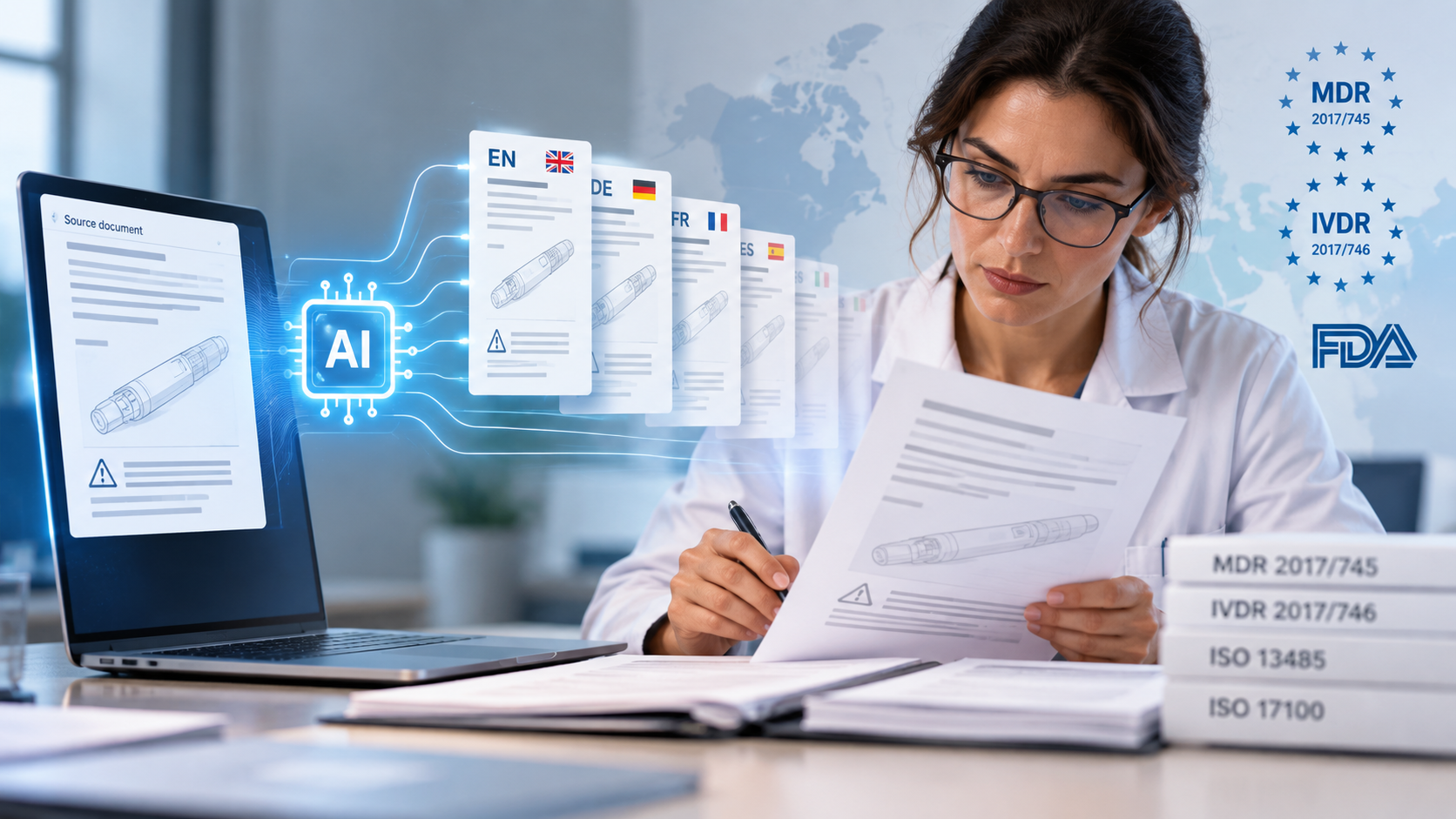
The translation industry has changed more in the last two years than in the previous twenty. Automated translation, powered by AI, has moved from a niche productivity tool to the dominant workflow across most of the market. Based on what we see from our own operation and from how the industry is moving, automated translation now accounts for more than half of global translation volume. That is not a forecast. That is where we are today.
This article is not an argument against machine translation. We use it. Most professional language service providers do. The question worth asking is a different one: where does it work well, where does it fall short, and what does that mean when the content being translated has to be legally defensible?
Why machine translation has grown so fast
The answer is straightforward. It is faster, more convenient, and significantly cheaper than traditional human translation. But there is a nuance worth understanding.
Machine translation did not make translation cheap. It made the translation step cheaper. The cost that remains is the human one. A professional post-editor reviewing and correcting a machine-translated document still requires expertise, time, and domain knowledge. What has changed is that the machine handles the first draft, which reduces the total human hours required per project.
In practical terms, at Novalins we offer a machine translation service with two rounds of human review at around 15 to 20 percent less than equivalent human translation, depending on the language. That saving is real, but it reflects a shift in where human effort is applied, not the elimination of human effort.
Where it works well
Machine translation performs best on content that is well-structured, technically consistent, and not highly context-dependent. Websites, product descriptions, internal documents, customer support content, and standardised technical manuals are areas where quality is generally good and the workflow makes commercial sense.
Performance also varies by language. Romance languages tend to produce stronger results. Results improve the more widely a language is used on the internet, because the underlying models train on available text. The gaps tend to appear in less-resourced languages and in content where tone, register, and cultural nuance matter as much as accuracy.
Marketing is an instructive example. On the surface it seems simple: short text, clear messages. But companies have a voice, a way of speaking to their audience that is specific to them. Machine translation can produce a grammatically correct sentence and still miss the tone entirely. That is where a human editor adds something the machine cannot replicate.
Where “good enough” is not a legal option
There is a category of content where the stakes are different. Not because the technology performs worse, but because the consequences of an error are not a disappointed reader or a slightly off-brand message. They are a patient harm event, a regulatory non-conformity, or a product that cannot reach the market.
Medical device documentation falls into this category.
Under EU MDR (Regulation 2017/745) and IVDR (Regulation 2017/746), Instructions for Use, labelling, and technical files must be available in the official language or languages of each EU member state where the device is placed on the market. This is not a recommendation. It is a legal condition for CE marking and market access. MDR Article 10 makes manufacturers directly responsible for ensuring that devices are accompanied by compliant IFU in every required language.
The practical consequence is significant. A translation error in an IFU is not a linguistic problem. It is a compliance failure. Notified bodies, including TÜV, BSI, and DEKRA, audit translation completeness and accuracy as part of their technical documentation review. A missing language version or a translation that diverges from the approved source version is sufficient grounds for a non-conformity finding, which can delay or block CE marking entirely.
In the US, 21 CFR Part 820, now aligned with ISO 13485, requires that all documents, including translated IFU and labelling, be controlled under a documented management procedure. Any translated content submitted as part of a 510(k) or De Novo request must accurately reflect the cleared English-language indications for use.
Beyond audit risk, there is a more direct one. Consider what it means for a patient to read an IFU that has not been properly reviewed. A dosage instruction rendered incorrectly. A contraindication that did not survive the translation process intact. A safety warning that is grammatically correct in the target language but carries a different meaning than the source. These scenarios are not hypothetical. They are the reason regulators require human oversight, and why that requirement is unlikely to change regardless of how capable automated translation becomes.
How the process works in practice
The industry model that has emerged is not a choice between machine translation and human translation. It is a structured combination of both.
At Novalins, our standard service for regulated medical content runs machine translation through two rounds of human review. The first reviewer focuses on accuracy: ensuring that what the machine produced faithfully reflects the source, that terminology is consistent with the applicable standards and the manufacturer’s approved glossary, and that no meaning has been lost or altered in the translation process. The second reviewer looks at the output as a document: tone, register, naturalness in the target language, and whether the text reads as intended for its audience.
We also offer a single-review service, which is faster and more cost-effective but accepts some risk in the areas that the second reviewer would otherwise address: register, contextual nuance, and fluency. For internal documents or less critical content, that trade-off may be appropriate. For patient-facing documentation or anything going into a technical file, it generally is not.
What “expert” actually means
The human review step is only as good as the person performing it. Language competence alone is not sufficient for regulated medical content. The reviewer needs to understand the regulatory context, the applicable standards, and the clinical domain of the document.
At Novalins, we work exclusively in medical, pharmaceutical, and life sciences content. We do not translate outside this sector. Our network of reviewers includes specialists across clinical disciplines: oncologists for oncology documentation, veterinary specialists for veterinary medicine, regulatory affairs specialists for submissions and technical files. When a document requires someone who understands the clinical implications of a specific term, that is who reviews it.
This is not a differentiator we invented. It is a requirement of the frameworks that govern this content. The relevant standards, including ISO 17100 for translation services and ISO 13485 for medical device quality management, both point in the same direction: the process must be documented, the people must be qualified, and the output must be auditable.
Where this leaves us
Machine translation has already changed the economics of the translation industry, and that change is permanent. Arguing against it would be like arguing against any other tool that makes a process faster and more affordable when applied correctly.
But the conversation about AI replacing translators tends to flatten a distinction that matters enormously in practice. For most content, the question is how to use automation intelligently. For regulated medical content, the question is how to use automation in a way that does not compromise the human accountability that the regulation requires.
Those are different questions. They lead to different workflows, different team structures, and different expectations of what a language service provider actually does.
The machine does the heavy lifting. The expert makes it defensible. In this sector, you need both.