 Page up



What AI actually saves you on regulated medical documentation, and what it doesn’t
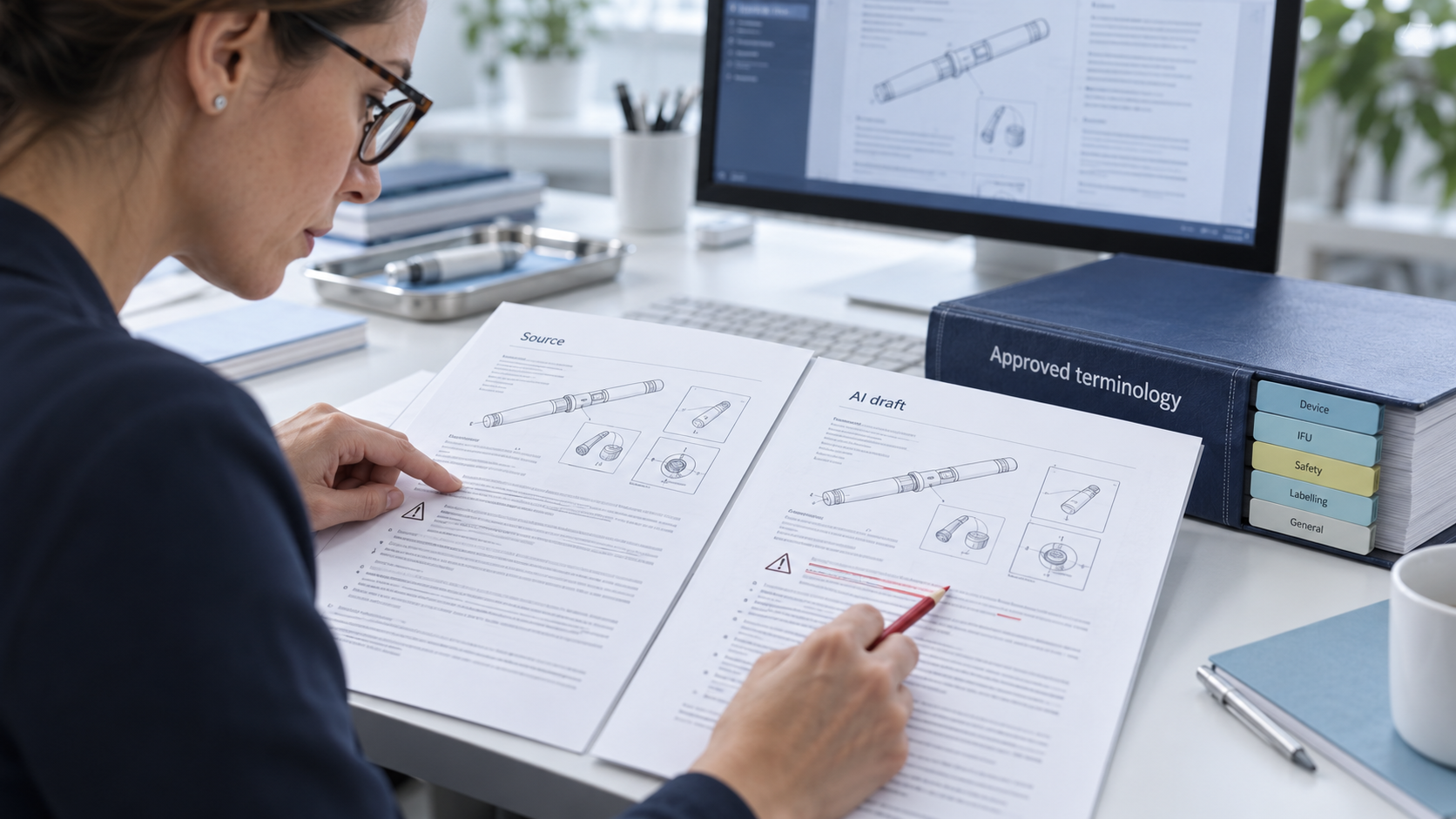
Life sciences companies are bringing AI into their multilingual workflows at speed, and a particular request has started to appear regularly in our inbox. The client has already run their regulatory documentation through a general-purpose AI tool, and asks us to provide only the human review.
The reasoning is sound on the surface. The translation looks finished, so only the review remains to be paid for.
The quotation tends to come as a surprise. Reviewing machine-translated regulatory content is not cheaper than translating it properly. In our experience it adds 10 to 20% to the workload, on top of the AI subscription the client is already paying for.
For teams preparing IFUs, SmPCs, labelling and clinical documentation under MDR, IVDR or EMA frameworks, the reasons are worth understanding before the decision is made rather than after the invoice.
The machine was never the expensive part
There is a widespread assumption that the cost of translation sits in the translation itself, and that automating it removes most of the expense.
It does not. Machine translation is a subscription and some compute. It is by a wide margin the least expensive component of the process. The cost has always been the specialist human work: the linguist who understands the regulatory context, the terminology and what an error in a patient-facing document actually leads to.
Automating the inexpensive part does not remove the expensive one. It makes it slower.
Why the review takes longer than the translation
Not all machine translation is equivalent, and the gap matters more in regulated medical content than almost anywhere else.
Translation memories. Every project we deliver builds a memory of that client’s approved wording. The next document reuses it, so terminology stays consistent between a device’s IFU, its labelling and its technical file. A general-purpose tool starts from zero every time. Inconsistency between documents covering the same device is precisely what reviewers notice.
Client glossaries. Device nomenclature, regulatory terminology and the specific phrasing a manufacturer has already settled on are not available to a general model.
Several engines rather than one. We run multiple engines over the same content and select the strongest output. A subscription tool gives you one output, and that is what you work with.
Medical specialisation. Our systems are built on medical and regulatory material. General models handle medical terminology competently right up until they do not, and the failures are rarely the visible ones.
What arrives is a file that reads as finished and is not. Our linguists report the same thing consistently, and it is the part clients find hardest to believe: correcting a fluent but incorrect translation takes longer than translating from the source. Every sentence has to be checked against the original rather than written once. Fluency hides the errors instead of exposing them.
It also creates friction we would rather avoid. Translators working on pre-translated files regularly tell us the effort exceeds what a review rate is meant to cover, and they are right.
The cost that shows up later
There is a second effect that does not appear on the first invoice.
When we handle a document end to end, the approved wording becomes an asset that belongs to your project. Terminology is captured, decisions are recorded, and the next submission starts from something rather than nothing. Over a product family, that compounds, and unit costs fall.
Work that originates elsewhere does not build that. Each document starts from scratch again, and the saving you thought you made on the first file quietly becomes a recurring cost on the next ten.
What we suggest
None of this is an argument against AI in regulated translation. We use it extensively. The difference is that ours runs inside a controlled process, with your memories, your glossary and a documented review behind it.
If your organisation is already committed to a subscription tool, we will take the review work, and we will tell you plainly when a file arrives in worse shape than the source.
If the decision is still open, there is a simpler way to settle it than any argument we could make. Ask for both quotations. Full translation by us, against your subscription plus our review, on a real document. Several clients have run that comparison and moved the whole process back to us, not because we persuaded them, but because the figures were clearer than we could have been.